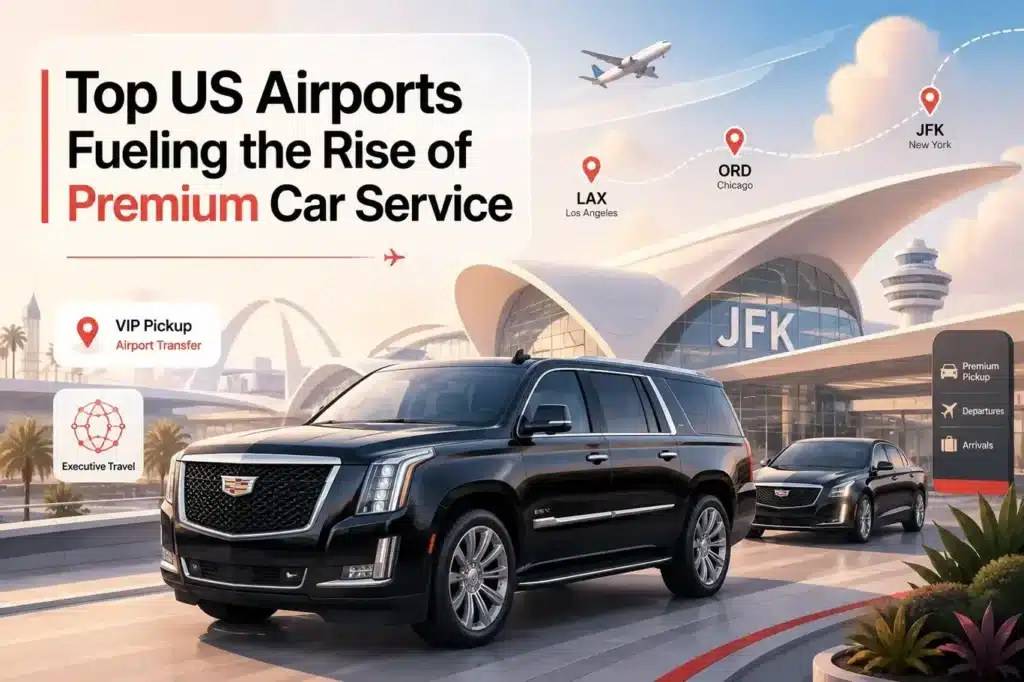
The Airport Is No Longer Just a Gateway
Think about the last time you landed after a long-haul flight. Luggage in tow, tired, and suddenly facing a sea of ride-share surge prices or a taxi queue stretching out the door. Millions of American travelers face this exact moment every single day, and a growing number of them are choosing a different answer: a premium car service.
From the gleaming concourses of Hartsfield-Jackson Atlanta to the Pacific-facing terminals of LAX, the nation’s busiest airports are quietly becoming the most powerful demand engines in the luxury ground transportation industry. Post-pandemic travel recovery, record-breaking passenger volumes, and a fundamental shift in how executives and leisure travelers value their time have converged to create a boom that shows no signs of slowing.
This blog breaks down which airports are driving this surge, what the numbers actually say, and what it means for travelers, operators, and the future of premium mobility. We also discovered how top US airports are supercharging the premium car service boom from 2022 to 2026, shaping the future of luxury ground travel.
A Market in Motion
These figures tell a consistent story. As air travel hits records, the premium ground transportation segment is growing even faster. The US, home to six of the world’s twenty busiest airports per ACI World 2024 data, sits at the very center of this shift.
Which US Airports Are Driving the Demand?
According to Airports Council International, North America (ACI-NA), US airports collectively handled a record-breaking volume in 2024, with international passenger traffic growing by 8.7% and domestic travel rising by 3.8% over 2023. Four American airports now rank in the world’s top ten by total passenger volume.

Top US Airports by Total Passengers (2024)
Each airport serves a distinct traveler mix. DFW and ATL cater to massive corporate and connecting traffic; JFK and LAX handle the lion’s share of international arrivals; DEN and ORD have seen outsized domestic growth. But they share one thing in common: a traveler base increasingly willing to pay for reliability and comfort.
|
“2024 was a milestone year for North America’s airport industry as we collectively surpassed pre-pandemic passenger volumes for the first time since 2019.” Kevin M. Burke, President & CEO, Airports Council International, North America |
Why Chauffeured Car Service? The Traveler Mindset Has Changed
The post-2022 travel boom was not a simple return to normal. It was a reset. Travelers, particularly frequent business flyers, came back with new priorities. A Deloitte survey found that 59% of respondents now prioritize convenience when selecting transportation, far ahead of cost at 27% and flexibility at 14%. This shift in values is the engine behind chauffeured car service growth at airport hubs.
Why Travelers Choose Premium Cars Over Ride Share?
| Driver | What It Means | Relevance at Major Airports |
| Time certainty | Fixed pickup, no surge pricing | Critical at ATL, ORD, DFW |
| Safety & vetting | Professional, background-checked drivers | High priority at JFK, LAX |
| Productivity | Work in transit with Wi-Fi and privacy | Key for corporate users at all hubs |
| Flight tracking | Driver adjusts to real-time delays | Universal demand across all airports |
| Consistency | Same vehicle class, same experience | Corporate accounts at DFW, ORD, and DEN |
On top of traveler preferences, the corporate travel sector is a massive tailwind. The Global Business Travel Association (GBTA) projected global business travel spending to reach $1.48 trillion by the end of 2024, with forecasts pointing toward surpassing $2 trillion by 2028. That spending flows directly into markets like executive airport transfers, where premium car service is often the default rather than the exception.
The FAA’s own Terminal Area Forecast (TAF) reinforces this trajectory. San Francisco (SFO), JFK, and San Diego (SAN) are projected to grow the fastest among large hub airports, at annual rates of 4.3%, 3.8%, and 3.6%, respectively.
The Numbers Behind the Executive Car Service Surge
Premium Ground Transportation Market Snapshot (2022 to 2026)
| Segment | 2022 Value | 2024 Value | 2026 Est. | CAGR |
| Global Chauffeur Services | ~$19B | $27.8B | ~$32B | 7.20% |
| Airport Transfer Services | ~$2.8B | $3.72B | $4.8B | 13.50% |
| Airport Ground Transport (Global) | ~$21B | $24.7B | $27B est. | 4.60% |
| Limousine Services Market | ~$16B | ~$18B | $20B+ | 8.10% |
The airport transfer services segment is the standout performer with a projected CAGR of 13.5%. That is nearly three times the pace of the broader ground transportation market. Airport-specific demand is uniquely recession-resistant: business travelers book regardless of economic cycles, and leisure travelers are increasingly treating the airport ride as part of the overall travel experience.
The chauffeur car market’s airport transfers segment alone was valued at $8.0 billion in 2024, according to Wise Guy Reports, making it the largest single application within the chauffeur car market globally.
Beyond 2026: The Future of Luxury Car Service
The trend lines point firmly upward. IATA forecasts global air passenger traffic to reach 5.2 billion in 2026, a 4.4% increase over 2025. ACI World projects global passenger numbers to hit 17.7 billion by 2043, nearly double today’s levels. More passengers mean more arrivals, more departures, and more moments where travelers need to decide how they get from Point A to Point B.
FAA Fastest-Growing Large Hub Airports (Projected, 2022 to 2050)
| Airport | Code | Annual Growth Rate | Premium Car Potential |
| San Francisco International | SFO | 4.3% per year | Very High |
| John F. Kennedy International | JFK | 3.8% per year | Very High |
| San Diego International | SAN | 3.6% per year | High |
| Dallas / Fort Worth | DFW | Strong domestic and international. mix | Very High |
For premium car service operators, these projections signal where to invest. SFO caters to Silicon Valley’s tech executive class, one of the world’s highest-value corporate travel segments. JFK serves the international premium traveler market, where 56% of traffic is international. DFW has seen the largest percentage growth surge of any major US airport in recent years.
Technology Is Raising the Bar
Real-time flight tracking, instant booking apps, and dedicated terminal greeter services are now baseline expectations. Operators that integrate GPS-based flight monitoring and one-tap mobile booking are capturing a disproportionate share of the corporate travel account market.
Sustainability Is Becoming a Differentiator
As airports like LAX invest $30 billion in modernization ahead of the 2028 Los Angeles Olympics, premium car operators face growing pressure to electrify their fleets. Services offering Tesla Model S, BMW iX, or Mercedes EQS pickups are already commanding a loyalty premium among ESG-conscious corporate clients.
The Post-Pandemic Trust Economy
After years of supply-chain chaos and unreliable ride-share surges, travelers have learned the cost of a bad airport transfer. According to Flight Center’s Corporate State of the Market survey, 40% of businesses plan to increase their travel by 2025, but with stricter vendor standards. Luxury car services, with fixed pricing, professional drivers, and accountability, are emerging as the reliable default for quality-conscious travelers.
FREQUENTLY ASKED QUESTIONS
Q. What makes private car service different from a regular ride share?
You get a vetted professional chauffeur, a fixed rate with no surge pricing, real-time flight tracking, and a guaranteed vehicle class. Ride shares offer none of these consistently.
Q. Which US airports have the highest demand for premium cars?
ATL, DFW, ORD, LAX, and JFK lead by volume. JFK stands out for premium demand specifically: 56% of its traffic is international, heavily skewed toward corporate and high-net-worth travelers.
Q. How far in advance should I book an airport car service?
Book at least 24 to 48 hours ahead for most airports. During peak seasons such as holidays, summer, and major conferences, 3 to 5 days in advance is the safe call.
Q. Is premium car service only for business travelers?
Not at all. The leisure segment hit $4.49 billion in 2024 (Technavio) and is growing fast. Families, couples, and solo travelers all use it to skip the stress of surge pricing and unfamiliar cities.
Q. Will prices rise as airports get busier through 2026?
Expect modest increases at most. Growing competition, with the market expanding at 13.5% CAGR, keeps base pricing in check. Top-tier electric and concierge services will cost more.